
What Quitman County Deed Records Convey
A recorded deed does several jobs. It names the parties, describes the land, and places the instrument in the official county record. Quitman County deed records deserve close reading. Check the acknowledgments, exceptions, reservations, and the legal description. Then compare the deed with later instruments that affect the same tract.
| Deed Type | What It Does | Common Use |
|---|---|---|
| Warranty deed | Conveys the stated estate with covenants expressed in the instrument | Ordinary purchase transfer |
| Quitclaim deed | Passes whatever interest the grantor holds without promising its extent | Family or title-cleanup transfer |
| Trustee deed | Conveys through a trustee acting under stated authority | Trust or foreclosure-related transfer |
| Executor or fiduciary deed | Conveys through an estate representative | Probate or estate administration |
| Tax deed | Records a transfer tied to the applicable tax-sale process | Delinquent-tax proceeding |
A deed conveys an interest in land. A deed of trust only secures an obligation, and a lien or lis pendens can burden the property or warn of a claim without conveying ownership. Searching deeds alone can miss real encumbrances.
The Quitman County Chancery Clerk Holds the Index
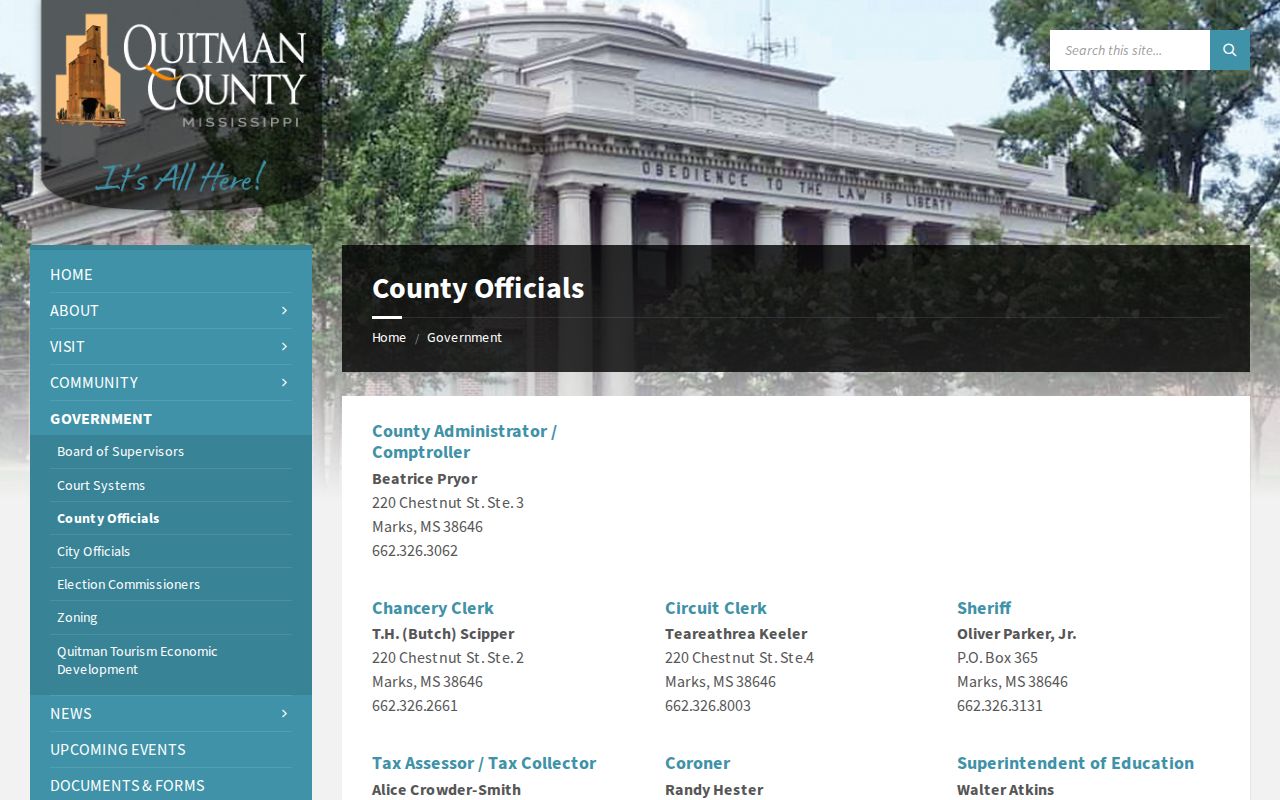
Quitman County's official instructions route land deeds to the Chancery Clerk. T.H. (Butch) Scipper's office sits at 220 Chestnut Street, Suite 2, Marks, MS 38646, and the phone is 662-326-2661. LTAMS lists weekday hours of 8:00 a.m. to 5:00 p.m. Confirm access before you travel. The county offers no online land-record index. A missing web result proves nothing. Visit the counter, call for routing, or send a written request listing the parties, parcel, instrument type, legal description, and approximate recording date.
Walk the Quitman County Grantor-Grantee Chain
Grantor and grantee roles turn one deed into a chain. Start with the latest known deed or the tax owner. Match land descriptions at every step. A shared surname is not enough. An older rural instrument may not list an address at all.
- Locate the current owner's acquisition deed with that owner indexed as grantee.
- Read the grantor, recording date, book/page or instrument reference, and full legal description.
- Search that grantor as an earlier grantee and compare the land, acreage, and exceptions.
- Repeat until the county books end, then test predecessor counties for pre-1877 land.
- Grantor
- The party transferring the stated interest.
- Grantee
- The party receiving the stated interest.
- Chain of title
- The linked sequence of conveyances affecting the same land.
- Book/Page or instrument number
- A recording reference used to retrieve the filed document.
Quitman Deed Books Begin with County Formation
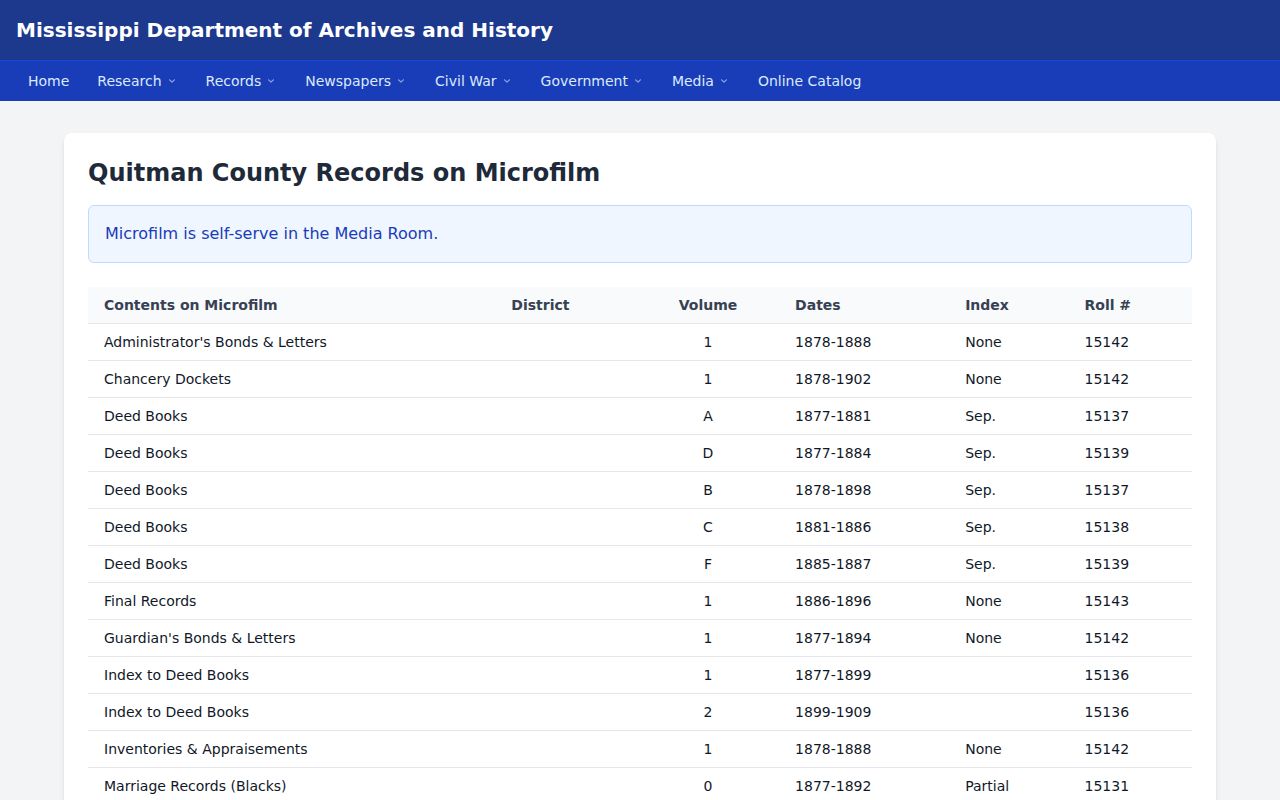
Quitman County formed in 1877. The county's deed series begins that same year. The Mississippi Department of Archives and History finding aid lists deed indexes for 1877-1899 and 1899-1909, along with overlapping deed books A, B, C, D, and F. The microfilm is self-serve material in the MDAH Media Room. It is not available for loan.
| Historic record | Coverage | MDAH lead |
|---|---|---|
| General deed index, volume 1 | 1877-1899 | Microfilm roll 15135 |
| General deed index, volume 2 | 1899-1909 | Microfilm roll 15136 |
| Deed Book A | 1877-1881 | Roll 15137 |
| Deed Book B | 1878-1898 | Roll 15137 |
| Deed Books C, D, and F | Overlapping 1877-1887 runs | Rolls 15138-15139 |
Those dates trace an archival finding aid, not the full range of current courthouse holdings. Complete online coverage after 1909 is not available.
Belen, Riverside, and Marks in Old Deeds
Place names can shift while the land stays in one chain. Quitman County history places the first seat at Belen. The seat moved west in 1880. It returned to Marks in 1910, after the Belen courthouse burned in 1908. The town was also called Riverside. When a family paper uses one of those names, search the legal description. Search the early deed books too. The historical account does not report destroyed deed books. Treating the fire as a records gap would go beyond the record. The safer conclusion is narrower. Old place aliases and physical custody changes make book, page, party, and land-description checks worth the effort.
Indexes Beside Quitman County Deeds
LTAMS identifies separate local indexes beyond the general deed books. Deeds of trust, substitutions, sectional entries, plats, lis pendens, construction liens, federal tax liens, federal civil judgments, powers of attorney, wills, and drainage district records each have their own place in the clerk's system. A clean deed sequence proves little. The other indexes may still show claims.
| Deed of trust | Check borrower, lender, legal description, assignments, substitutions, and recorded release. |
|---|---|
| Lis pendens | Read the related court matter and its disposition or release. |
| Plat or map book | Use the recorded subdivision or survey reference behind lot-and-block language. |
| Construction or federal lien | Match parties, dates, land, and any satisfaction or withdrawal. |
Ask the Chancery Clerk which index covers the instrument in question. The general deed index is not a universal search.
Estate Transfers Can Break a Simple Deed Chain
An owner can die with no routine sale on record. Quitman County records hold wills and probate minutes. Administrator and guardian materials are there too. Chancery dockets from the county's early years round out the set. Those papers explain an executor, trustee, heir, or estate name. The conveyance affecting title still has to be found. MDAH's digital Quitman series holds selected land and personal records, including 1890s material. FamilySearch offers a statewide wills and deeds collection through a free account. Its indexing and image access vary, and the county clerk remains the local custodian.
Request a Quitman County Deed Copy
Quitman County offers no public online land-image system. Start with the Chancery Clerk. Give the office grantor and grantee names, the parcel or legal description, the deed type, a date range, and any book and page reference. Say whether you need a plain or certified copy. Ask for the current fee estimate and electronic delivery if offered. LTAMS publishes recording guidance under Miss. Code §25-7-9, but copying and certification details should be confirmed with the clerk for the exact request. The Mississippi Public Records Act backs a written, specific request when counter service falls short. Skip the everything-about-this-property ask. Named indexes and dates narrow the task for everyone.
Recorded, not guaranteed. Quitman County deed records show what was filed and indexed. They do not promise clear title, resolve unrecorded interests, or replace a professional title examination.
Use the Legal Description to Hold the Chain Together
Older Quitman County deeds often describe big farm tracts by acreage, metes and bounds, or the section-township-range grid. Roads, rivers, and drainage ditches are thrown in as landmarks. A town lot works differently. It depends on a recorded plat and a lot-and-block reference. Street addresses help as search clues, but they are weak for continuity. The legal description is the better thread to follow. Split and combined parcels create the real trap. Today's parcel number may not appear anywhere in the older deed. Trace the parent tract instead through acreage, adjoining owners, watercourses, and plat references. The Quitman County GIS map is only a visual aid. Pull the actual deed and plat and compare them. A polygon on a map is not a survey. It cannot repair a break in the paper chain of property records.
Date Every Quitman County Deed Finding
Log the date of each Quitman County deed search along with the index consulted. Note the parties, instrument type, recording date, book and page reference, and legal description. A plain statement that the latest deed went unreviewed keeps a name match from masquerading as a finished chain of title.