
Trace Quitman County Former Owners Through Time
Work from the newest verified conveyance into successively older sources, one step at a time. Skip ahead too fast and the chain breaks. Quitman County publishes no online land-record index. So the Chancery Clerk remains the main route for recent deeds. For the early county period, the Mississippi Department of Archives and History provides a precise microfilm trail. Plats and old tax rolls help bridge those parcel-identity gaps. Still, only the deed itself proves who conveyed the land.
| Ownership source | Documented span | Access point | Best historical clue |
|---|---|---|---|
| General deed index | Current range not published online | Quitman County Chancery Clerk | Grantor, grantee, instrument and deed reference |
| MDAH deed indexes | 1877-1909 | MDAH microfilm roll 15136 | Names and deed-book/page leads |
| Deed Books A, B, C, D and F | 1877-1898, with gaps by volume | MDAH rolls 15137-15139 | Full early conveyances and legal descriptions |
| Map/plat book | Range not stated | Chancery Clerk | Subdivision, lot and block context |
| Probate and will series | 1877-1934, varying by series | Chancery Clerk and MDAH | Estate authority, heirs and fiduciary links |
Modern transfers live in the clerk's current general deed index. Ask there first. Once a chain nears 1909, the MDAH Quitman finding aid gives the exact roll to cite. It also names the right book. The MDAH Quitman finding aid catalog page displays the detailed county series.
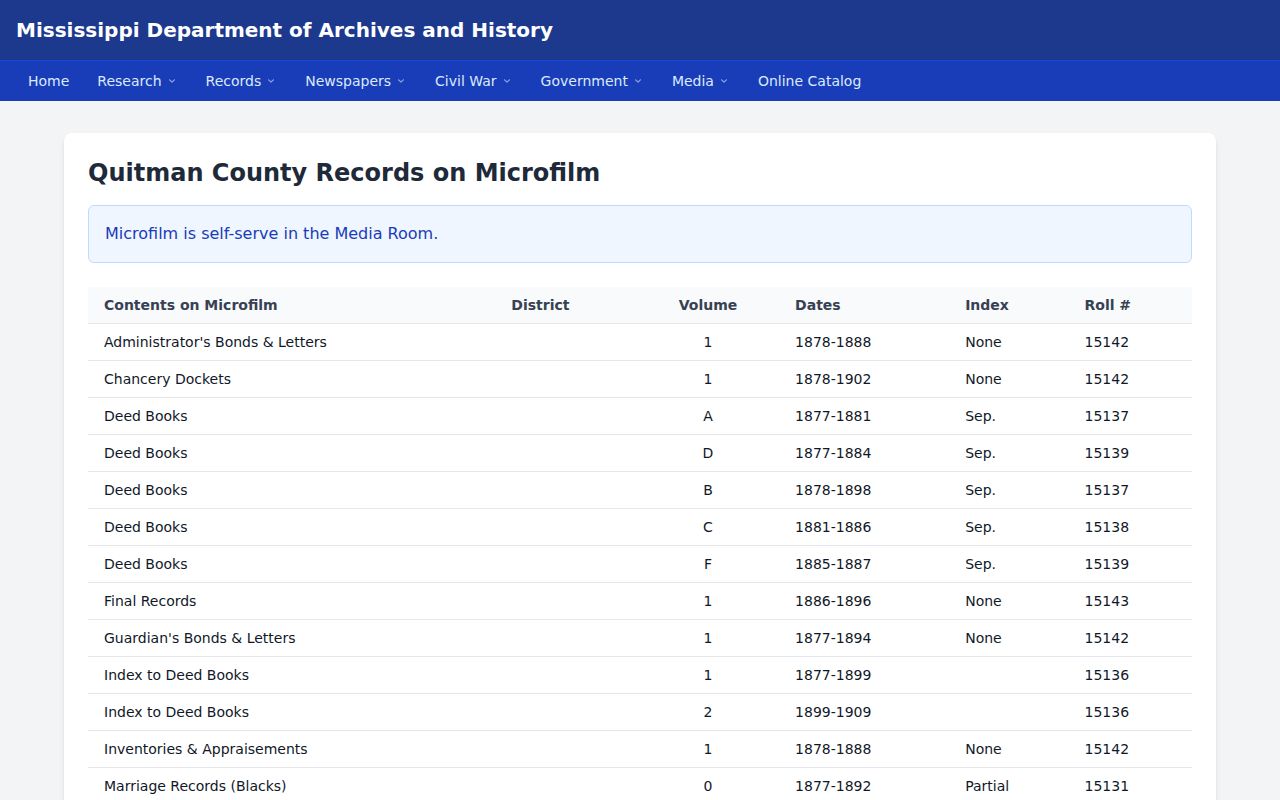
The volume-level dates keep claims honest. Not every early deed sits online. They also let a researcher request one specific roll instead of asking broadly for all former owners.
Start Quitman County Previous Owners With the Latest Deed
The newest deed supplies the first dependable backward link. Search the current grantee first. That instrument's grantor is your next owner of record. Note the instrument or book and page reference, execution and recording dates, deed type, consideration if shown, and the complete legal description. A street address alone anchors poorly, because older rural Quitman County deeds often rely on acreage, section-township-range, roads, rivers, or metes and bounds.
| Transfer date | Grantor to grantee | Instrument | Continuity key |
|---|---|---|---|
| Newest located deed | Prior owner to current grantee | Deed type and reference | Legal description and parcel |
| Earlier acquiring deed | Earlier grantor to that prior owner | Book/page or instrument | Same tract or explained parent tract |
| Next backward link | Repeat with the new grantor | Earlier index entry | Acreage, lot/block and exceptions |
A timeline is a method, not a title chain. Never fill its rows with assumptions. Each row must trace to an inspected index entry or document tied to the same land.
Deed type matters too. A warranty, quitclaim, trustee's, fiduciary, or court-linked deed may convey a different interest, and each stems from a different event. Read what the instrument grants and reserves. If burdens on the property count as well, search the separate deed-of-trust, substitution, release, lien, and lis pendens indexes.
Quitman County Former Owners in the 1877-1909 Index
Quitman County was formed in 1877 from parts of Tunica, Coahoma, Panola, and Tallahatchie counties. That date shapes every ownership search. MDAH lists deed-index volume 1 for 1877-1899 and volume 2 for 1899-1909 on roll 15136. Full deed books sit on their own rolls. Books A and B share roll 15137, book C occupies 15138, and books D and F fill 15139. No source documents earlier Quitman County former owners more clearly.
Land held before 1877 may trace into one of those predecessor counties. Never project today's county name backward. Check the date and the geography first. Old references to Belen, Old Belen, or Riverside can describe land in the modern Marks area, so compare the legal description before treating the place name as a different tract.
MDAH catalogues the holdings as “Quitman County records, 1877-,” RG-00/Series 2050, in the self-serve Media Room. The microfilm does not circulate. Requests route more easily when they cite roll 15136 for the indexes before asking for a deed-book roll. FamilySearch offers a statewide wills-and-deeds collection too. Coverage and indexing vary. Verify county, book, page, and land.
Note: The documented index reaches 1909, and no authoritative source confirms complete online coverage for every later Quitman County deed.
Reconstruct Quitman County Prior Owners Backward
The Chancery Clerk keeps the general deed index and related land books at 220 Chestnut Street, Suite 2, in Marks. Quitman County publishes no online deed-index portal. Plan a visit, call, or written request. Give the clerk a party name and rough date. Add the deed type, parcel or legal description, and any known book and page so the search stays narrow.
- Locate the newest deed in which the present owner appeared as grantee.
- Read the grantor, legal description, deed type, date, and recording reference.
- Search that grantor as an earlier grantee and match the same land description.
- Repeat until the county index ends, then continue in MDAH's deed indexes and books.
- Grantor and grantee
- The conveying party and the party receiving the stated interest.
- Chain of title
- The ordered sequence of instruments affecting the same land.
- Reverse index
- An index organized to help locate a party on the receiving side of a deed.
- Warranty and quitclaim
- Different conveyance forms whose legal effect must be read from the instrument, not inferred from the label alone.
Keep Quitman County Previous Owners With the Same Tract
A modern parcel number can fail to reach an older conveyance after a split, recombination, or land-roll update. The earlier deed may cover a parent tract. Compare acreage, section-township-range, lot and block, road or watercourse references, exceptions, and adjoining-owner calls before trusting a match.
A shared surname proves nothing. A shared street proves little more. The Quitman County AssuranceWeb search supplies a present tax-year lead by parcel, address, name, bill number, or company. Save the parcel and situs data it shows. Then take the legal-description question to the recorded deed. For the mechanics of a single instrument, use the Quitman County deed records guide.
Note: A parcel split can leave today's identifier newer than the ownership event, so keep every prior parcel and parent-tract reference.
Probate Can Bridge Quitman County Past Owners
A chain of arm's-length deeds can hit a wall. Death, estate proceedings, guardianship, or a court-ordered transfer interrupts it. Quitman County probate work runs through Chancery. Its historical series is deep: administrator bonds and letters from 1878-1888, inventories and appraisements from the same years, probate minutes from 1877-1900, final records from 1886-1896, and will records from 1878-1934.
These estate files answer a narrow question. They show who held authority to convey the land, and why an estate name appears in the chain. They are not a substitute for the conveyance itself. Once you spot an executor, administrator, guardian, heir, or court order, go back to the deed index and find the fiduciary deed or later instrument that actually moved the property.
Keep three questions apart. Who died? What authority did the Chancery Court grant? What document conveyed the parcel? A will can name beneficiaries without proving a deed was ever recorded. An inventory can list real estate yet offer no modern parcel number. Tie the estate land to the deed through acreage, section-township-range, lot and block, or another stable element of the legal description.
Three Routes to Older Quitman County Ownership Records
When a web search stalls, Quitman County still has solid physical and archival routes. The Chancery Clerk keeps the current deed, plat, lien, and will indexes. MDAH's Media Room holds the county microfilm for self-serve use, with no lending. FamilySearch carries a statewide Mississippi wills-and-deeds collection. A free account may be needed, and indexing is incomplete. The MDAH digital Quitman series lists 31 items, including 1892 land material. Its item-level detail points to specific leads.
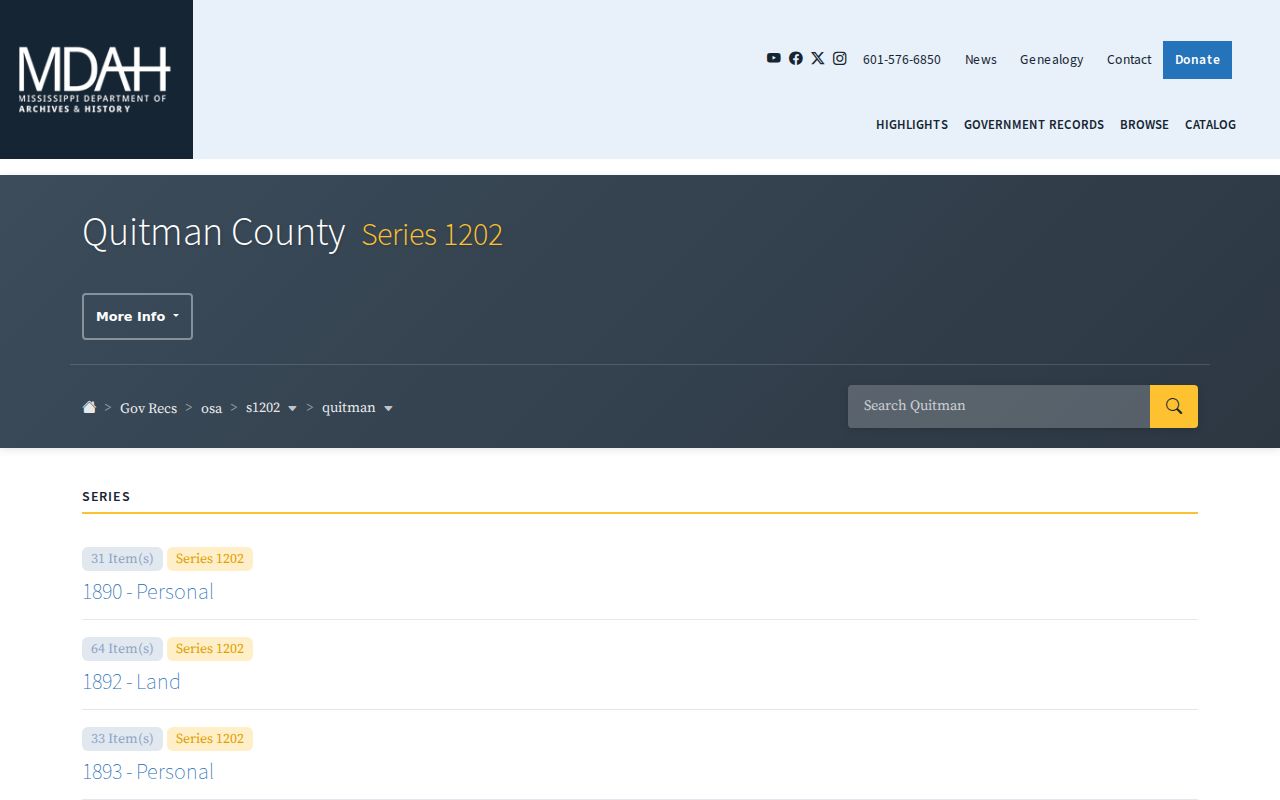
Digital items supplement the record. They are not proof that every deed book has been digitized. If neither digital route settles the chain, request a specific roll or book from MDAH, or ask the clerk for a narrow index search of Quitman County deed records.
Belen, Riverside, and the Quitman County Record Trail
Place names in Quitman County have shifted. The county's official history puts the first county seat at Belen. It moved west in 1880. After the Belen courthouse burned in 1908, the seat returned to Marks in 1910. The town that became Marks was first called Riverside. These details matter when old papers name an unfamiliar place. It may no longer match any modern mailing address.
The fire is not proof a particular deed was destroyed. MDAH still identifies early deed books and indexes beginning in 1877. Treat the courthouse story as a prompt to check surviving volumes and alternate repositories. It is no license to declare an ownership gap. That call requires examining the relevant deed records and series.
Historic names help most with family papers, old abstracts, and handwritten notes. Such notes often never cite a modern situs address. A place label narrows the context. The deed's land calls settle whether the paper concerns the parcel. Railroad and river references often outlive a local name change, too.
Know the Limits of Quitman County Former-Owner Records
Quitman County's documented trail starts with county formation in 1877. That is not necessarily where the land's history begins. Earlier ownership may sit in a predecessor county's deed records. Later gaps may stem from an unindexed image. Gaps may also stem from a different instrument series, probate proceedings, a changed parcel, or a name variant. The Chancery Clerk's deed index, deed-of-trust index, sectional index, map/plat book, lis pendens, liens, and chancery books are separate tools. A deed-only property search can miss context that shaped the parcel.
For a focused request, name the parcel or parent tract. Also give the record type, the parties, and a date range. The Mississippi Public Records Act supplies a written-request framework for existing public records. It is subject to exemptions, redaction, actual-cost fees, and each custodian's procedure. Ask for an estimate. Request electronic copies of Quitman County property records where available.
Lawful use. Researching Quitman County former owners is appropriate for property history, estate work, and purchase diligence. Do not use records to target, track, or harass a living person.