
Separate the Quitman County Property Value Types
Keep the label attached to each number. Mississippi Department of Revenue guidance starts from true value, applies the statutory ratio for assessed value, and uses millage to compute the final tax. Each label answers a different question. A sale consideration belongs to a conveyance record, not the tax roll, and speaks to history rather than current worth.
| Value type | Meaning in this search | Record source |
|---|---|---|
| True or market value | Local mass-appraisal estimate before the class ratio | Assessor land roll |
| Assessed value | True value multiplied by the applicable statutory ratio | Assessment record |
| Taxable value | Assessment after applicable exemptions or adjustments | Tax and assessment record |
| Sale consideration | Amount or consideration stated for a past conveyance, if shown | Recorded deed |
Mississippi applies different ratios by property class. Owner-occupied residential real property is generally assessed at 10 percent of true value, other real property at 15 percent, and utility property at 30 percent under the DOR class framework. The class ratio drives the math. Verify a parcel's classification with the assessor rather than assuming it from street appearance.
How Mississippi Produces Quitman County Assessed Value
The Mississippi DOR property-tax guidance lays out a simple sequence. Multiply true value by the assessment ratio to get assessed value. Bring in millage later, when the tax bill is computed. This page stops at valuation meaning. The Quitman County property tax records guide covers the rest. That page handles bills, exemptions, and local review.
| Property class | Assessment ratio | Reading caution |
|---|---|---|
| Owner-occupied residential real property | 10% | Confirm the parcel's classification and homestead status |
| Other real property | 15% | Do not classify from appearance alone |
| Utility property | 30% | State-assessed treatment may apply |
The ratio also explains a puzzle. Assessed value can sit far below true value without signaling a discount. The gap is statutory, not a market signal. To see the method, identify the county's true-value label first. Apply the verified class ratio next. Consider millage only afterward. Never calculate from a guessed class, and never substitute a tax-due figure for assessed value. If the record's wording differs from DOR terminology, preserve the portal label and ask the assessor how that field maps to the state formula.
Use AssuranceWeb for a Quitman County Value Lead
The county's AssuranceWeb Property Search puts Tax Year and Search By controls up front. Search modes cover Name, Bill #, Company, Parcel, and Address. Name mode adds its own options. Pick last-name starts-with or contains. Then enter the owner's last and first name. No value field appears before results load. Open a live parcel record first. The screenshot shows the portal's visible entry points for a Quitman County property value search.
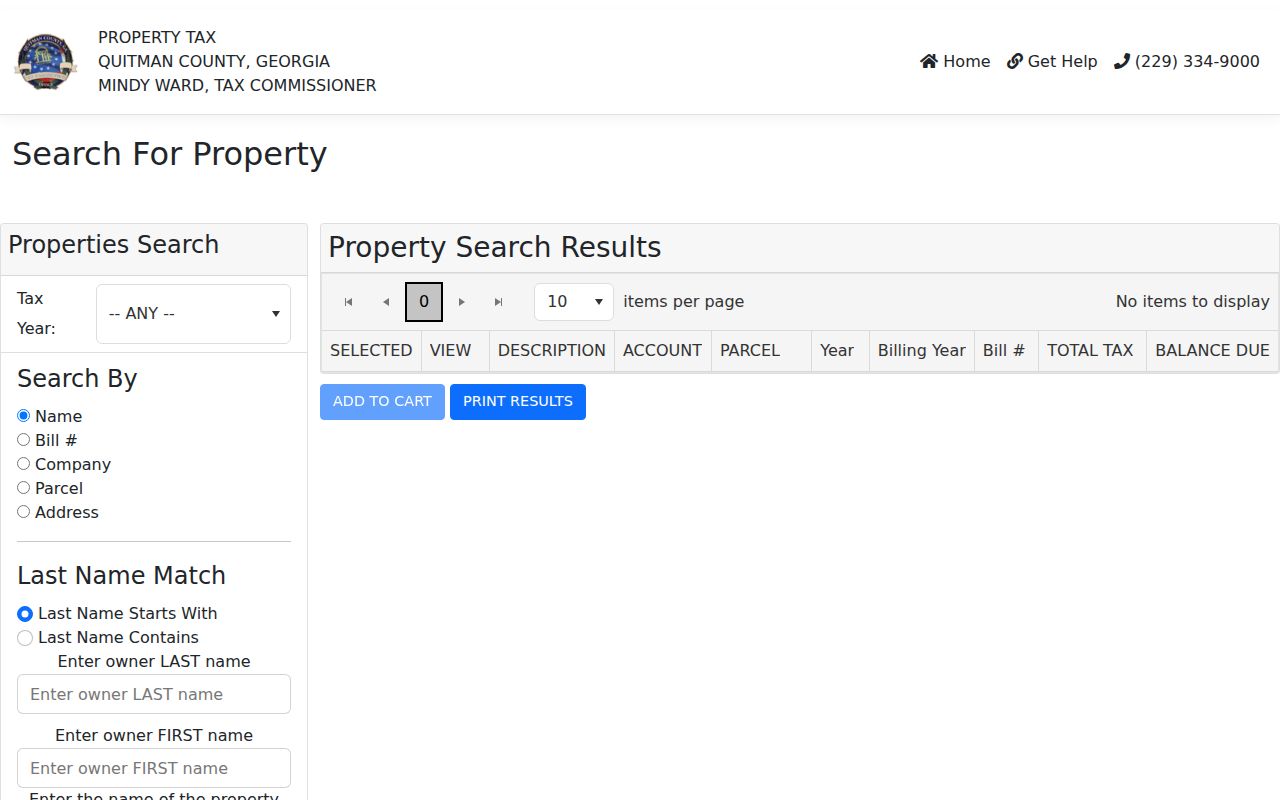
Record the portal's exact labels, the chosen tax year, and the parcel ID from any result. Keep each figure separate. Land, improvement, true, assessed, exemption, taxable, and tax-due amounts answer different questions, so transcribe them one by one rather than collapsing them into a single value. Write down the tax year too.
Look Up a Quitman County Property Value by Year
Let the parcel control the comparison. The tax year is the time stamp. Address search works for discovery, but rural road wording, street direction, mailing-versus-situs differences, or a changed parcel can cause a miss. Once the parcel number is known, rely on it for every year the live portal offers.
- Select the tax year in AssuranceWeb and search by the known parcel or address.
- Copy every displayed value label exactly and keep land and improvement components separate if present.
- Repeat with the same parcel for another available tax year, noting any split or recombination.
- Inspect the recorded deed for historical consideration, then keep it separate from the assessment.
- Assessed value
- True value after the applicable Mississippi class ratio is applied.
- True or market value
- The local mass-appraisal estimate that begins the assessment formula.
- Assessment ratio
- The statutory percentage used to convert true value into assessed value.
- Reassessment
- The process of updating property values across the jurisdiction.
Quitman County Values Follow a Four-Year Revaluation Floor
Mississippi real property must be revalued at least once every four years, according to the DOR local appraisal guidance. Personal property is appraised annually. Local assessors do the appraisal and assessment work. DOR oversees uniformity across counties. A parcel can also change mid-cycle through new construction, demolition, land changes, corrections, or reclassification, so year-to-year differences do not share one cause.
Quitman County publishes no revaluation notice or city-level value trend online. Before calling a change a market trend, ask the Assessor/Tax Collector which valuation year and land-roll status a result reflects.
DOR notes that local officials physically inspect property regularly. An interior inspection is not required. That mass-appraisal process serves uniform taxation across many parcels. It differs sharply from a private appraisal. A private appraisal targets one property, one effective date, and a particular valuation assignment.
Note: A four-year revaluation requirement does not freeze every parcel between cycles or move all values at the same rate.
Recorded Sale Price Is a Separate Quitman County Fact
A deed may state consideration for a transfer. That amount is not current market value. Family conveyances, estate transfers, quitclaim deeds, multi-parcel sales, exchanged interests, and nominal consideration can all make a deed figure unlike an open-market price for one present parcel. Read the full instrument and legal description.
Quitman County offers no online deed index. The Chancery Clerk at 220 Chestnut Street, Suite 2, in Marks, holds the recorded instruments. Request copies by party name, approximate date, parcel or legal description, and deed type. Match the conveyed tract.
Land, Improvements, and Exemptions Are Not One Value
A Quitman County parcel record often breaks value into parts. Land sits apart from buildings and other improvements. Exemptions sit apart again. A taxable figure follows from all of them. The exact fields on the county's result card should be read from the live record rather than presumed. If a label you expect is missing, ask the Assessor/Tax Collector in Suite 1 for the full assessment detail.
Keep each field in its own lane. Homestead is a tax classification and an exemption lead. It is not proof of who owns or occupies the property today. A mailing address only tells you where tax notices go. It can differ from the situs address where the land actually lies.
Value shifts deserve a second look too. Rising improvement value may trace to recorded property characteristics or fresh appraisal work rather than a recent sale. A changing taxable figure may come from exemption treatment instead of any change in the land. Quitman County publishes no public calculation worksheet. Ask for the assessment detail and its source year before explaining any cause.
Compare Quitman County Property Values Without Mixing Parcels
Compare Quitman County property values on a like-for-like basis. Parcel IDs can change after a split or recombination. A current parcel may descend from a larger parent tract. A two-year comparison can silently measure different land. Before calculating any change, confirm the acreage, legal description, land and improvement components, and parcel history. Also confirm the tax year.
Neighboring assessments help only when the parcels share the same class and valuation frame. They cannot replace a comparable-sales analysis. The county offers no neighborhood comparable-sales tool and no municipality-level trend. Treat nearby figures as loose context. Rural tracts need the closest watch of all. One deed can cover several parcels or a whole parent tract that the current tax roll now divides. Adjoining parcels can still differ in acreage, improvements, access, water features, and classification. A same-year neighbor comparison stays descriptive evidence. It is not a direct estimate of what the subject would sell for.
Note: Match parcel, class, and tax year before comparing assessments. A tidy percentage may otherwise hide a different tract.
Know What a Quitman County Property Value Cannot Prove
An assessed value answers to the tax roll, not the market. The assessor's figure serves a mass-appraisal purpose. It cannot promise what a buyer will pay, what a seller will accept, or what a licensed appraiser will conclude after walking the property and choosing comparable sales. A consideration amount on a deed is equally limited. It looks backward, and it may cover unusual terms or more than one tract.
Let each record do its own job. The tax record explains official valuation labels; the deed records explain a past conveyance. For a current market opinion, retain a Mississippi-licensed appraiser. For a dispute about the assessment, preserve the tax year and result, then contact the Quitman County Assessor/Tax Collector for the current correction or review procedure. The county posts no local deadline or form online.
Assessment is not an appraisal. A Quitman County assessed value supports taxation and is not a forecast of sale price. Use a licensed appraisal for a current market-value opinion.